
MTSS vs. RTI: What’s the Difference (and Why it Matters)
The alphabet soup of school systems can feel overwhelming. People often use RTI (Response to Intervention) and MTSS (Multi-Tiered Systems of Supports) to mean the same thing, but they aren’t the same and using them interchangeably can lead to confusion.
When you understand how the systems work together, you can advocate for more targeted, proactive support for your child before the IEP process even starts.
MTSS = Multi-Tiered Systems of Supports
MTSS is a systematic framework for school support. It encompasses all students and addresses academic, behavioral, and social emotional needs. Some states have their own iteration of MTSS (for example: GATSS https://gadoe.org/whole-child-supports/gatss/) and over 90% of states within the US implement some form of MTSS.
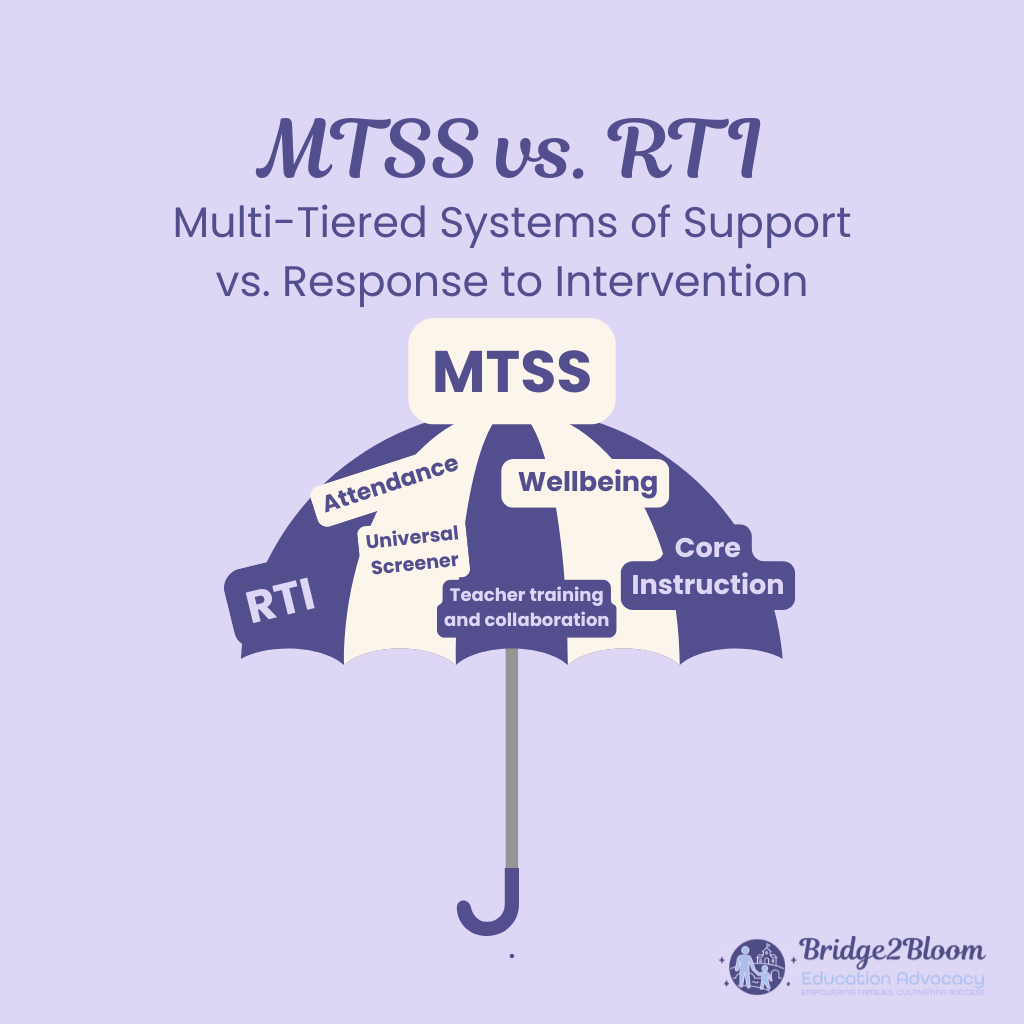
This visual of MTSS shows some of the key components. Each state and/or district implements MTSS a little differently, so this may not be exactly what you see in your school.
RTI = Response to Intervention
RTI is a component of the MTSS framework to support students who are struggling either academically or behaviorally. This is a data-driven process, meaning teachers should be using universal screenings (assessment given to all students in the school 2 to 3 times a year to gauge overall progress), benchmark assessments, and classroom tests, in addition to student observations, to determine which students need more support.
Important Note: RTI supports occur within general education, not special education. In most cases, a student would receive RTI support BEFORE an IEP is implemented.
How They Connect
Think of MTSS as the recipe for success within the school. It includes school culture, curriculum and instruction decisions, and social-emotional support for all students.
Key Question: Do the systems and structures within the school support every learner’s success?
Think of RTI as a crucial step in the recipe. It includes targeted interventions for students who are struggling with reading, math, or behavior.
Key Question: Is this intervention working for this learner?
If your child is not making progress in reading, math or is struggling with behavior, the school may start implementing interventions targeted to your child’s specific needs. This is typically done BEFORE a referral for special education. If your child is receiving RTI supports, you should ask for periodic data review meetings (every 8 - 10 weeks) to look at progress and success of the interventions.
If the interventions are not working, there are few paths you could take:
The school may change the intervention type, frequency of the intervention, or duration of intervention sessions.
The school may request to conduct an evaluation for special education.
As a parent, you can request an evaluation for special education at any time.
References and Additional Resources:
Confused by the supports available to your child? You don't have to navigate this complex system alone. At Bridge2Bloom Education Advocacy, we partner with families to ensure your child receives meaningful access and support at school.
👉 Click here to schedule an initial consultation with Bridge2Bloom today to discuss how we can support your child's educational journey.
